Quality per Token: The Tradeoff Nobody Puts on the Invoice
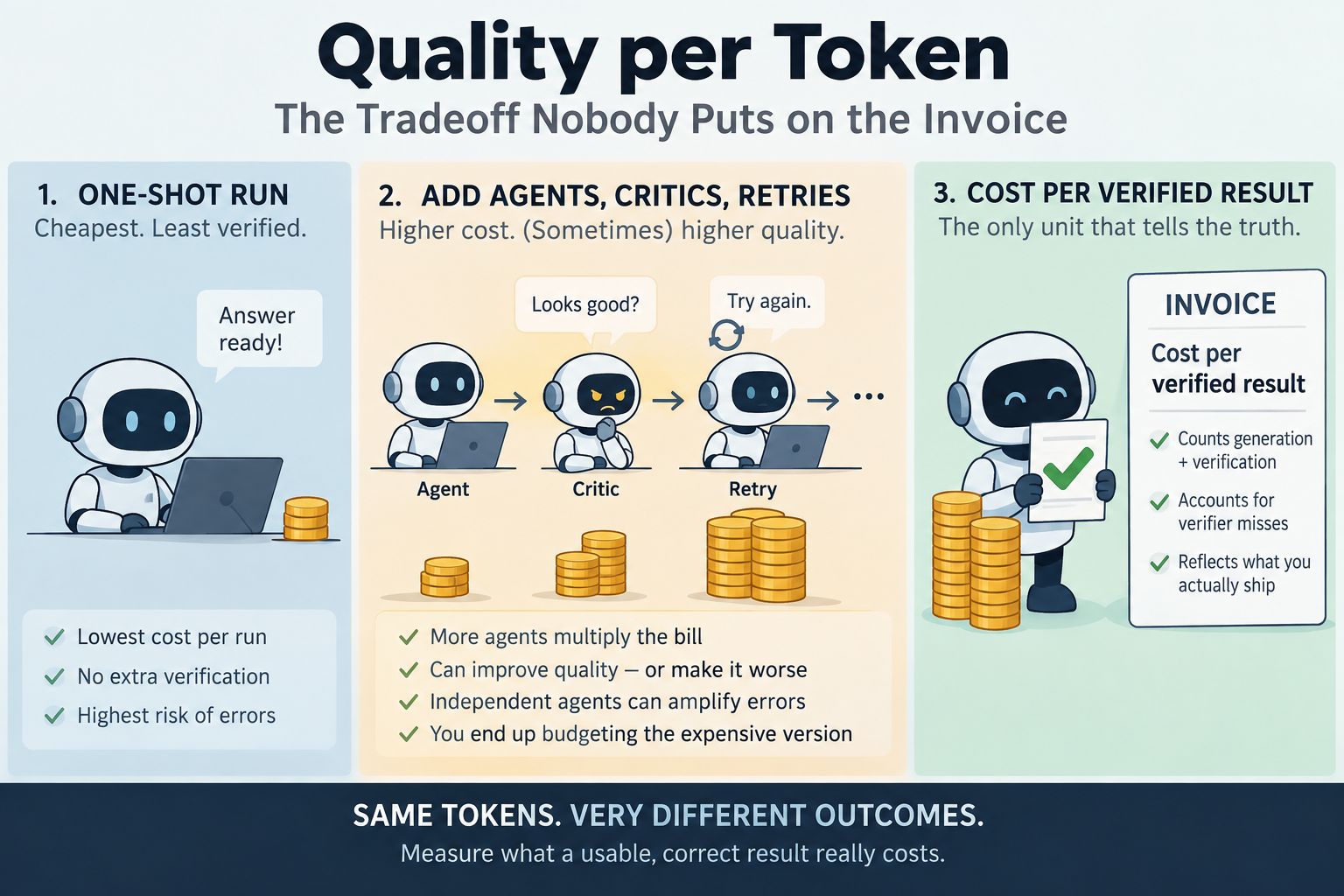
A single-agent, one-shot run is the cheapest thing you can buy from a model. It is also the least verified thing you can buy. Every step that raises confidence — a second agent, a critic, a verifier pass, a retry — multiplies the token bill. Teams budget the cheap run and ship the expensive one, and the gap never appears on the invoice because the invoice is denominated in tokens, not in verified results.
The unit that should be on the invoice is cost per verified result. Not cost per run, not cost per task attempted, not tokens per month. And it has to count the verifier’s misses, because a verifier that says “pass” when it shouldn’t has cost you money and given you nothing.
Two earlier posts set this up: AI-assisted testing adds a validation layer, it doesn’t remove one, and a batch is not an increment — verification is where the bottleneck moved. This post is about what that bottleneck costs, and why the way most teams count it hides the number.
Three prices for the same task
The same task can carry three very different price tags depending on what you count:
| What you count | What it tells you | What it hides |
|---|---|---|
| Cost per run (tokens x price) | What the API bill will say | Whether the output was any good |
| Cost per task, averaged over attempts | How expensive the model is to use | Failed attempts are paid for but produce nothing |
| Cost per verified result | What a usable outcome actually costs | Requires a verifier — and the verifier can be wrong |
Leaderboards that publish cost at all, such as Artificial Analysis, report the second. Most budgets are drawn on the first. Almost nobody reports the third — and the third is the only one that matches what the business receives.
“More agents” is not a dial that only goes up
The usual reflex when a one-shot run isn’t good enough is to add agents: a planner, a worker, a critic, a coordinator. That reflex assumes more agents means more quality, and the only question is how much it costs.
The best recent evidence that this assumption is wrong comes from Google Research (Kim et al., Towards a Science of Scaling Agent Systems, arXiv 2512.08296, v3 2026-04-08). Across 260 configurations on 6 benchmarks, the effect of going multi-agent ranged from +80.8% (decomposable finance tasks, centralized coordination) to -70.0% (sequential planning tasks). Same lever, opposite sign, depending on the task shape.
The mechanism is error amplification: in their measurements, independent agents amplified errors 17.2x, versus 4.4x under centralized coordination (same paper). More agents means more places for an error to enter and more paths for it to propagate — unless something in the architecture is catching it.
Their predictive model picked the best architecture for 87% of held-out configurations (same paper). Read that both ways: the choice is predictable enough to be worth making deliberately — and unpredictable enough that “just add agents” will be the wrong call for a meaningful share of tasks.
So the tradeoff isn’t “cheap and unverified” versus “expensive and better.” Sometimes it’s “cheap and unverified” versus “expensive and worse.” That’s the version nobody budgets for.
The unit: cost per successful task
Arize and Fireworks ran the measurement I wish every team ran on its own workload (vendor-run study — both companies sell inference or evaluation tooling; “Cost per successful task”, July 2026). Setup: 40 Terminal-Bench tasks x 10 models x 6 trials = 2,400 runs, $626 total. Their definition of the metric: total spend across all attempts divided by the number of successful runs. Failed attempts count toward the numerator and contribute nothing to the denominator.
Selected results from that study:
| Model | Pass rate | Cost per success |
|---|---|---|
| gpt-oss-120b | 33% | $0.054 |
| gemini-3.1-flash-lite | 40% | $0.063 |
| GPT-5.5 | 67% | $0.636 |
| Kimi K3 | 66% | $0.670 |
The cheapest model per success had the worst pass rate in the table, and still came in roughly 12x cheaper per success than GPT-5.5 (Arize/Fireworks). A one-in-three model that costs almost nothing per attempt beats a two-in-three model that costs a lot per attempt — if, and only if, you can afford to retry and you can tell which run succeeded.
That conditional is the whole point. The study’s own nuance: cheap-per-success works there because the tasks were retried and graded deterministically (Arize/Fireworks). Terminal-Bench has a test harness that says pass or fail. Your ticket queue doesn’t. Take away the deterministic grader and the “cheap” model’s 67% failure rate stops being a retry budget and becomes 67% of output that somebody has to check by hand — which is exactly the validation layer from the 2026-09-07 post.
Cost per task is not the same number, and the difference is the point
Styles and Miller (WorkBench Revisited, arXiv 2606.13715, v2 2026-07-01) report cost per task alongside completion rate:
| Model | Completion | Cost per task |
|---|---|---|
| Claude Fable 5 | 97.7% | $0.355 |
| Gemini-3.1-pro | 95.5% | $0.076 |
| GPT-5.5 | 94.9% | $0.206 |
| Gemini-3.5-flash | 92.0% | $0.067 |
| DeepSeek-V4-pro | 84.2% | $0.017 |
Their conclusion: “buying the last few points of completion costs roughly an order of magnitude more per task than settling just below the top of the table” (Styles & Miller).
Note the unit: this is dollars per task attempted, not per successful task. The two only converge when completion is near 100%. At the top of this table they’re close — my arithmetic, not theirs: $0.355 / 0.977 is about $0.36 per success for Fable 5, and $0.017 / 0.842 is about $0.02 for DeepSeek-V4-pro. At 84% completion the correction is small. At the 33% pass rate in the Arize table, cost per success is three times cost per attempt. Conflate the two and the cheap models look cheaper than they are exactly where it matters most.
Two more data points on cost at the top of the table, weaker but consistent:
- Terminal-Bench 4.0 on Artificial Analysis now publishes an average cost per task and a score-vs-cost chart — the metric exists on a mainstream leaderboard. Per a third-party leaderboard summary (codingfleet, 2026-09-25; secondary source), Codex with GPT-6 Astra scored 58.2% at roughly $3.3k for the full evaluation, against Claude Code with Fable 5.1 at 57.9% at roughly $6.2k — the same score at about 2x the cost.
- One individual blogger’s aggregation (dev.to, levash0v, 2026-07-07; indicative only) found a
single task,
pytorch-model-cli, cost between $0.001 and $1.47 across 47 successful runs — a 1,109x spread for the same passing result — and that moving from roughly 62% to 87% score cost around 10-30x more.
The shape repeats across three unrelated measurements: the last few points of quality are priced in multiples, not percentages.
The verifier is a cost line too — and it can lie
If cost per verified result is the unit, then whatever does the verifying is part of the cost. The obvious move is to make the verifier cheap. LangChain and Harvey tried exactly that for legal agents (vendor blog — LangChain sells the orchestration tooling; “Designing efficient verifiers for legal agents”, 2026-06-02):
- Batching verification criteria and switching to open models gave roughly an order-of-magnitude cost reduction.
- Opus and GPT-5.5 as verifiers agreed with each other 95.7% of the time.
- DeepSeek v4 Flash as a verifier was 60-1000x cheaper than the frontier options.
And the bill for that saving:
- Haiku as a verifier had a false-pass rate of 48.4% per criterion, and 34.7% in batch mode (same post). Nearly half of the things it should have failed, it passed.
- Batch mode — the cheaper configuration — had lower agreement with the reference than per-criterion checking (same post).
A false pass is the worst outcome in the whole pipeline: you paid for the generation, paid for the verification, and still shipped the defect — now with a stamp on it saying it was checked. So the cost-per-verified-result formula needs a term for verifier misses. In words: what you spent, divided by the number of results that were actually correct, not the number the verifier said were correct. If your verifier passes 48% of what it should have failed, your denominator is inflated and your real cost per verified result is much higher than the dashboard shows.
This is not an argument against cheap verifiers. It’s an argument that the verifier’s miss rate has to be measured before its cost saving can be claimed. The Harvey post did measure it; that’s what makes the numbers usable. Most teams don’t.
What to put on the invoice
Opinion from here on, labelled as such.
- Budget the configuration you will ship, not the one you demoed. If the pilot ran single-agent one-shot and the production setup has a critic and two retries, the production bill is a multiple of the pilot bill. Estimate the multiple before the pilot is approved, not after the first month’s invoice.
- Report cost per verified result, and say what “verified” means. Deterministic test harness, LLM (large language model) judge, human review — each has a different miss rate, and the number is meaningless without it.
- Measure the verifier before trusting its savings. Take a sample the verifier passed, check it by hand, and record the false-pass rate. The Harvey figures show it can be near 50% for a cheap model; assume nothing until you’ve measured your own.
- Treat “add an agent” as an experiment with a sign, not a slider. The Google data says the effect can be -70%. Try the single-agent baseline first, and add coordination only when the task decomposes cleanly.
- Retry is a cost strategy only where grading is free. Cheap-per-success models win on benchmarks with a harness. If a human is the grader, every retry lands in the verification queue from the last post.
The honest gap
- Two of the six sources are vendor-run. Arize/Fireworks sells evaluation and inference; LangChain sells orchestration and wrote up a customer. Their numbers are specific and the methods are described, but nobody independent has reproduced them.
- No source computes cost per verified result with verifier misses included. Arize defines cost per success with a deterministic grader; Harvey measures verifier false-pass rates. The formula that combines them is my construction, not a published metric.
- Cost per task and cost per success are from different benchmarks. WorkBench and Terminal-Bench are not comparable task sets; the per-success conversion I did on the WorkBench numbers is arithmetic, not a finding of that paper.
- The Terminal-Bench 4.0 cost comparison is second-hand. Artificial Analysis publishes the metric; the $3.3k vs $6.2k figures come from a third-party summary and I haven’t verified them against the primary chart.
- The dev.to aggregation is one person’s collection. Directionally consistent with the preprint and vendor data, but not evidence on its own.
- The Google paper’s task categories may not map to yours. “Decomposable finance tasks” and “sequential planning” are their benchmark labels. Whether your workload decomposes is something you have to classify yourself, and the 87% predictor is theirs, not a tool you can run.
- A term called “cost-of-pass” exists in the literature. I’m not citing its figures here; the framing in this post rests on the sources above.
Where this goes next
- AI / processes — retry-until-pass is a benchmark trick, not a production strategy: the “cheapest per success” result above depends on a deterministic harness and free retries; in real work the grader is a human, so every retry is an entry in the verification queue, not a free roll of the dice. The angle: take one workload with and without an automated oracle, price the retry loop under each, and expose the point where the cheap-model advantage flips into a cost.
- AI / processes — can you tell single- vs multi-agent before you spend the tokens? the Google spread from +80.8% to -70.0% hinges on task decomposability, and their 87% predictor isn’t something a team can run — so the single-vs-multi choice is made by reflex, not by classification. The angle: derive a practical decomposability checklist from the paper’s task categories, apply it to a real backlog, and show which tickets would have been made worse by adding agents.
- Testing / AI — false pass vs false fail, the asymmetry nobody prices: cheap verifiers trade false fails (rework, visible) for false passes (shipped defects, invisible until later); the two errors have very different costs but get reported as one “agreement” number. The angle: split verifier error into its two directions, attach a cost to each from incident and rework data, and show why “95.7% agreement” can hide an unacceptable false-pass bill.
- Testing / AI — the leaderboard grades the run; production grades the outcome: score-vs-cost charts now exist on mainstream leaderboards, but the grader is a benchmark harness whose definition of “pass” matches no team’s Definition of Done — so leaderboard cost per task doesn’t transfer. The angle: take one leaderboard task, re-grade its “passing” runs against a realistic acceptance criterion, and show how much of the published pass rate survives.